This next school-year, I have an opportunity to teach math within my science and social studies classes. Our sixth-graders simply need more minutes to think about and work on mathematics. The students and teachers at my school are grouped into villages of 75 to 90 students. The students are divided into three groups who move together between their math, science, social studies, language arts, PE, and exploratory classes. This next year, I will be able to take some minutes from my science and social studies classes to teach math.
For the last six years, I’ve often embedded mathematics within my science and social studies lessons. Prior to the 2011-2012 school-year, I taught sixth-grade math for 15 years. I am excited that now I can design specific math lessons that will help my students build a solid mathematical knowledge base and support the mathematics that they learn in their core mathematics class.
If you were asked to take some time from your content area to teach math each day, what would you do if these were your sixth-graders?
For me, some possible responses are:
- support the core math lesson taught each day (review homework, explain concepts);
- pull review questions from the state test question bank;
- design a support curriculum based on my experience as a sixth-grade math teacher
As I thought about my answer to this question, I had to consider the really big elephant in the room that cannot be ignored. That is why it is an elephant in the room. This elephant is the memorization of basic multiplication facts, although, students knowing their multiplication facts is just the very surface of a much deeper issue. My 21-year experience has been that my students not only do not know their multiplication facts, they have very little understanding of multiplication. Furthermore, they have very little understanding of place value, of fractions, – of most things, mathematical. So, rather than an elephant in the room, you might think of these issues as a herd of elephants stampeding through a China shop with no one noticing!
Consequently, my answer to the question above regarding, “… what would you do …” is to design a math support curriculum. I started with the simple idea that my students would work on a fraction problem every day for 180 days. I would keep the time short, approximately 20 to 30 minutes, just doing a small amount each day. As I thought more about this, I realized that the Big Daddy of all Elephants is the conceptual understanding of multiplication. A conceptual understanding of multiplication forms the basis for a deeper understanding of fractions. This means that the beginning fraction problems must be very simple if I hope to have kids do one fraction problem each day and teach and understanding of multiplication that will include rote memorization of single-digit multiplication facts. As I think about these two big ideas – multiplication and fractions – and how to teach them while, at the same time, teaching science and social studies, this teaching seems to be a daunting task. But now, what to teach gets more complicated because of my students’ understanding of place value.
If I’m going to teach multiplication and fractions, eventually I will have to include the concept of place-value. As I thought beyond single-digit multiplication problems, place-value became an important concept to understand. For example, I want students to be able to calculate 200 x 5.7 without hesitation. Students should, at least, be able to estimate by changing the problem to 200 x 6; so, 2 x 6 = 12, and 12 x 100 = 1200 (200 x 5.7 = 1140, which should make sense to students as they investigate the relationship between the problem, the estimate, and place-value).
Sixth grade is the most critical grade for kids to develop and deepen their basic understanding of math. Usually, students will not be given the opportunity to deepen their understanding of very basic math concepts in 7th grade, 8th grade, and beyond. Sixth-grade teachers cannot lose sight of the critical nature of 6th-grade math. The moment teachers begin to race through the curriculum is when students’ understanding of basic math concepts is undermined. This is why I say, “It’s the math, silly!” Slow down and teach math concepts rather than rote procedures. Support kids’ mathematical thinking.
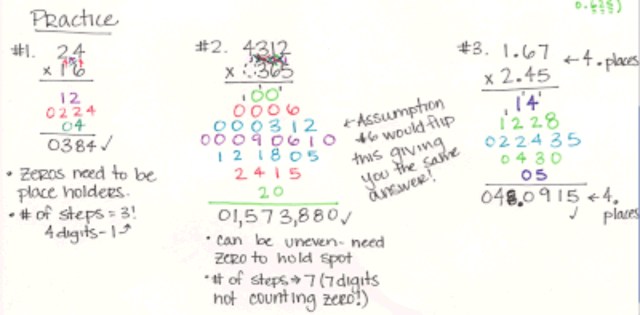
Based on the reasoning above, I plan to begin the school year teaching place value, multiplication, and simple fraction concepts. While researching different methods of multiplication, I discovered a method called “copper plate multiplication”. I can use this method to frame both place-value and multiplication into simple puzzle-like problems. This is where I will begin – two-digit multiplication as an approach to teach place-value and provide kids time to memorize basic multiplication facts.
This is the subject of my next post – NOT; I decided to introduce multiplication and our base ten system of numbers followed by place value. Soon, I will write about copper plate multiplication and how to use it for multiplication facts practice and an understanding of place value. Below is an image of copper plate multiplication. It is the middle example (#2) of the practice problems.
Copper Plate Multiplication
 It's All About The Math