Students will begin by discussing multiplication as equal groups of things. They will provide examples of “things” and “groups”. I will give kids some things to work with: centimeter cubes, pennies, beans; and, some containers in which to place those things: plastic bowls, coffee cans, circles on paper. Take the time to have kids do this. Sixth-graders need this time. Have them think about it – all aspects of it: things, groups, equal groups – write about it, and explain it. Students should include drawings in their writing – what are the images that they are building in their heads as they work through these simple examples?
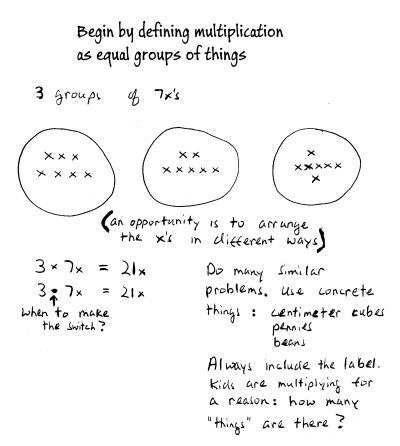
Figure 1: Define multiplication as equal groups of things.
Kids do this work so that they can complete (think, write, explain) a simple task: Compare equal groups to unequal groups. How do you determine the total number of things you have?
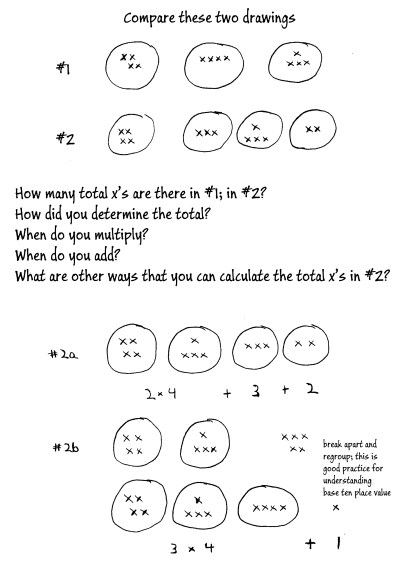
Figure 2: Compare calculating the total number of items when the groups are equal to when the groups are not equal. Show different ways to make this calculation.
My kids will do many problems like those shown in Figures 1 and 2, above. When they compare equal groups to unequal groups, they begin to develop a basic understanding of Order of Operations – the most simple example of why the numbers in a multiplication problem cannot be separated leading to the idea that multiplication should be done before addition. Look at Figure 3, below. Multiplication must be done first (“must” be done first is not quite right, see below) because the three bags are connected to – are grouped with – the 5 apples in each bag. To separate the bags from the apples, multiply. You are taking the apples out of the bags and calculating that there are 15 apples. Now, they can be added to the 3 apples and the 7 apples.
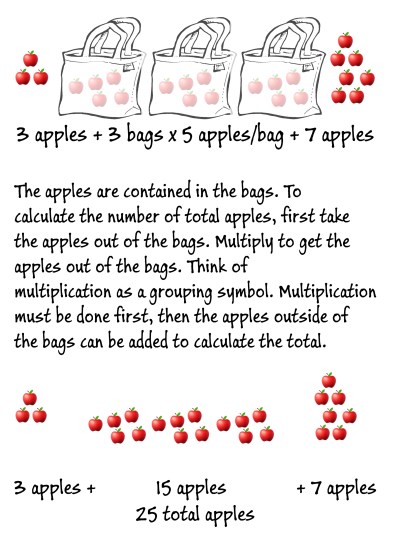
Figure 3: The apples in the bags must be counted first (multiplication) to calculate that there are 15 apples all together in the three bags. The multiplication does not have to be done first. You could add the 3 apples to the 7 apples. However, you cannot separate the three bags from the five apples in each bag. Eventually, you will have to do this multiplication.
So, with the visual image of Figure 3, when students are presented with a problem such as:  they will have a good chance of seeing this problem as, “3 things + 3 groups of 5 things/group + 7 things”. They will view multiplication as a grouping symbol that should be done first or, at least, cannot be separated and must be done eventually.
Sixth-grade math is difficult. I will take lots of time to allow my students to build an understanding, yep, a conceptual understanding, of the math within these very simple problems. Once they have done many of the problems with the ability to think about them, to write about them, and to explain them, they will be ready to begin their understanding of our base ten system of numbers: place value.
Begin with the simple problem from Figure 1, above: 3 x 7. The 21 single units are arranged in groups of ten (base ten system). There are two groups of ten which equals 2 tens or twenty. This is huge for sixth-graders. The digit “two” is placed in the tens place to show that there are two groups of ten or 20. The simplicity defies the complexity of our base ten system of numbers. Kids need lots of practice with this simple idea of regrouping things into groups of ten. Soon, students will regroup ten groups of tens into ten tens or hundreds. They will then regroup ten hundreds into ten ten-tens or thousands. They would then regroup ten thousands into ten ten-ten-tens or ten thousands. Kids will get the idea even though it is cumbersome to write. At this time, keep this very simple at first – ones, tens, hundreds – because it soon gets very complicated.
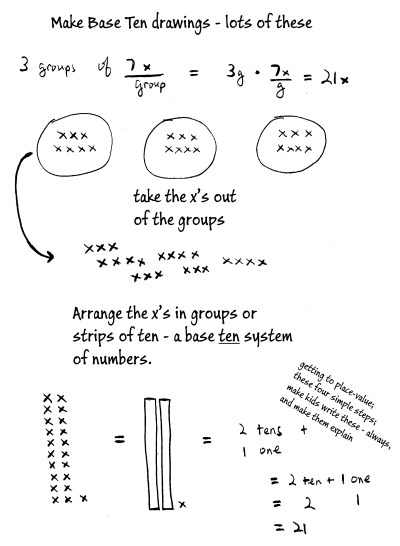
Figure 4: the beginning of thinking about place value
Okay, just two more problems based on 3 x 7 to build a beginning concept of base ten and place value.
3 x 70 can be drawn as 3 x (7 x 10). Another way to draw 3 x 7 x 10 is
(3 x 7) x 10, or 21 x 10. Students should make these drawing; compare them; and, explain them. They must build an understanding that the 3 x 7 in 3 x 70 is ones times tens. Ones x tens equals tens – 21 tens in this example. 21 tens can be rewritten (regrouped) as 2 hundreds plus 1 ten. To embed this idea, students make a drawing of 21 x 10 (Figure 6). When multiplying by a power of ten (10 to the 1st power), the digits remain the same, they simply get shifted to a different place value; one place value larger in this case.
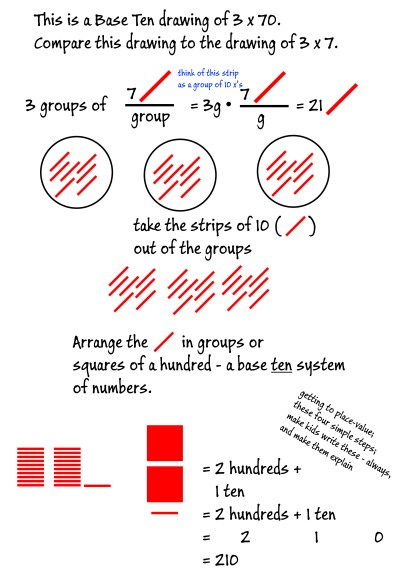
Figure 5: Base Ten drawing of 3 x 70. Compare this drawing to the drawing of 3 x 7 in Figure 4, above.
Notice that the digits, of which we only have ten, of the factors and the digits of the product in both 3 x 7 and 3 x 70 are the same (with the exception of the zero which a place holder): a “two” and a “one”. The products differ in the placement of the digits – place value. For the product of 3 x 70 (210), the digits are shifted one place value larger. The “two” is now placed in the hundreds place and the “one” is placed in the tens place to show a value of 210.
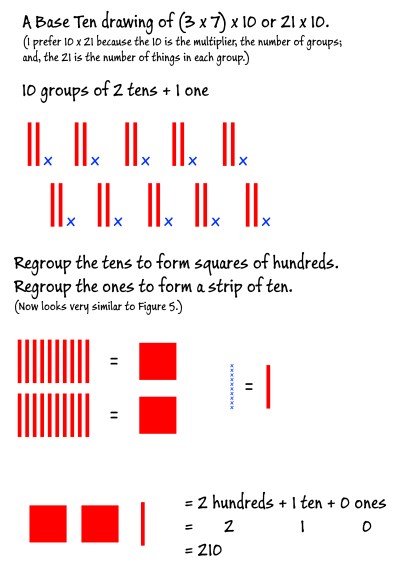
Figure 6: Base Ten drawing of 10 x 21. The digits remain the same, they just get shifted one place value larger because you are multiply by 10. What would happen if you were multiplying by 100? By 1000?, and so on.
 It's All About The Math