1. Challenge: write what you know about place value and number systems
2. Ones and Zero (ones; units)
3. The Tens Place
4. Counting to 1310 in Five Different Number Base Systems
5. Drawing the “Tens” Place (101) in Five Different Number Base Systems
6. The Language of Different Bases
ANOTHER CHALLENGE: naming numbers in different bases
7. Drawings and Names for 1112, 1113, and 11110
1. A Challenge
This post is my mental meandering about place value, base numbering systems, and their relationship. I am sorting through what and how to present place value and our base ten system of numbers to my sixth graders. There is much more here than I plan to present to them. This detail helps me sort through what to do. Before reading this post, I suggest that you write about how the position of a digit affects its value (place value) and base ten numbers. Remember that ours is a base ten place value system. Try to explain a base two system, although this system is difficult to explain. Other systems are easier to explain because the pattern becomes apparent. Explain a higher number systems such as base three or base four, then try to explain base twelve! I find this post difficult to write. This difficulty in writing reveals how confusing are the concepts of place value and base ten numbering system. It is important to have students work through many seemingly simple examples. Students must talk through the problems, explain the problems, and be able to write down those explanations.
[back to the top]
Hopefully, you have tried to write something. So, here goes …
.
2. Ones and Zero (ones; units)
Our commonly used system of numbers is based on groups of ten. It is a base ten system. Think of counting single items such as counting candies placed into a box. To keep track of the candies, you might count on your fingers: one, two, three and so on. Symbols were developed for each of these groups: 1, 2, 3 … . When you use up all of your fingers, you would think, “ten candies”. I imagine long ago there was a single symbol for ten. Today, sometimes people use an X. The system of numbers based on sixteen uses letters for values ten through 15: … 8, 9, A, B, C, D, E, F; so, a letter could be used for “ten”.
Eventually, a new digit was invented to go with the digits 1 through 9. This new digit was not a symbol for ten, it was a symbol for nothing: a zero (0). Now, the idea of groups of ten could be combined with single items or units. The full power of the system was realized when the position of the digits attained meaning: an amount based on the position of the digit, i.e., place value. The zero could be used as a “place holder” meaning, for example, that there are zero single units (ones) in counting an amount.
[back to the top]
.
3. The Tens Place
To keep track of your candies, you could package ten candies in a box. One box of candies equals 10 candies, 2 boxes equal 20 candies, 3 boxes equal 30 candies … so, 1 box of 10 = 10, 2 boxes of 10 = 20, 3 boxes of 10 = 30 and so on. In this case, the zero is used as a place holder. It shows that there are no single candies, just groups of ten candies. If you had five boxes of candies plus seven single candies that would equal 5 boxes of 10 = 50, plus 7 single candies which would equal 57 candies all together: 5 tens + 7 ones (units, singles, items).
The base ten aspect of our system of numbers developed because of our ten fingers, or digits. Items were grouped as tens. Other base numbering systems group different amounts together. Base 2: 2 groups of units; Base 3: 3 groups of units; Base 6: 6 groups of units; and, Base 12: 12 groups of units. Compare these four different base systems to base ten to observe what happens as you count up beyond one group. First, in Figure 1, below, units are shown up to the number of units one less than the base. Nothing unusual happens until base twelve. Each base has the number of digits of that base. Base two has 2 digits, base three has 3 digits, base six has 6 digits, base ten has 10 digits, and base twelve has 12 digits. For base 12, two new digits need to be created: a digit for 10 and 11 (  ) (link to images). I could have used letters or an X for ten and a different symbol for 11, but I think the unique symbols are less confusing for my sixth-graders. In the top row of Figure 1, the base is labeled as a power of 0 because a value to the 0 power equals 1. This is the beginning of using powers to label the place value. The zero power is the units or ones place. A “group” of that base has not yet been collected.

Figure 1: Four bases compared to base ten. The only base that has additional symbol(s) compared to base 10 is base 12: symbol for 10 and 11. The other bases use the same symbols. You could not tell the base for each drawing if it was not labeled because these drawings are of units or ones.
4. Counting to 1310 in Five Different Number Base Systems
Figure 2 shows counting up to 1310 (13 written in base 10) in four different bases compared to base 10. As the digits get used up, reaching 910 , 12 , 23 , 56 , and  12 (1110 ), in each base, addition of one more unit makes one group for that base. Consequently, the amount is written as “1” in the next higher place value and as “0” in the units or ones place. This means that there is 1 group of that base and 0 units or ones. The number, “10”, is the same for each base but with different meaning.

Figure 2: Counting to 13 in five different bases. What happens when the digits are “used up” and the digits move to the next place value higher (they “roll over”)?
5. Drawing the “Tens” Place (101) in Five Different Number Base Systems
A simple drawing of each of the five bases with one group of each base is shown in Figure 3a. Once the number of items (ones) reaches the amount of 1 group for that base, regardless of the base, the number is written as “10”: 1 group of that base plus zero units (items, ones). Notice that with increasing bases, the amount of units (ones) increases within a group.
Figure 3a also introduces the next higher place value above a power of 0: a power of 1. Above, we saw that a power of 0 = 1. Every number to the zero power (x0) = 1. Now, we see that every base number to the power of 1 has a group equal to that base.

Figure 3a: This figure shows the difference between labeling place value as powers of ten compared to “powers of the base”. For example, in base 6, there is no “6”. The amount or number “6” is written as 106 which equals one group of 6 ones. To help limit confusion, the subscript is included to show the base. The base to the power of zero equals units or ones for each base.
One group of a base with zero ones is written with the same symbols in each base: 1 x 101x + 0 x 100x = 1 x 10x + 0 x 1x = 10x + 0x = 10x . In teaching place value by comparing different base systems, we often write the expanded notation of the place value using symbols that do not exist in that base system. The caption for Figure 3b describes base 6 as an example. There are six digits in base 6: 0, 1, 2, 3, 4, 5; there is no “6”. Six is written as 10 in base 6. I’m sure that I have confused students in the past by writing 1 x 61 + 0 x 60 = 1 x 6 + 0 x 1 = 6 + 0 = 6, while, at the same time, saying that the digit “6” does not exist in base 6. We must take care in how we teach kids to switch between base 10 and other bases. We must give kids time to think through this concept.

Figure 3b: A comparison of one group in each base written in base x compared to base 10. For example, there are 6 digits in base 6: 0, 1, 2, 3, 4, 5. There is no “6” but in discussing base 6 with my 6th graders, I cannot avoid using some base 10 as I write the place values: 63 62 61 60 rather than 1036 1026 1016 1006 . By-the-way, in both cases (the place values written with “6” as the base and the place values written with “106” as the base) the base amount of the place values, written in base 10, equal 216, 36, 6, and 1, respectively.
6. The Language of Different Bases
When explaining other base systems, we are forced to use base ten language to begin the explanations. As stated in the caption for Figure 3b, we describe the base 6 system as having 6 digits knowing that the symbol “6” does not exist in the base 6 system of numbers! Writing the symbols is one issue. Finding the proper language that fits those symbols is another issue. What would you call one group of a base – any base – with zero ones (units)? The symbol will always be the same: 10.
[back to the top]
.
ANOTHER CHALLENGE: After deciding on a name for the “tens” place, name the numbers through 1310 in several different bases. This is what I did which is shown in Figures 5a and 5b.
I chose to begin by thinking about the labels for each place value (Figure 4). I think that it is okay to use “hundreds” and “thousands”. Ah, but what would you do when you get to “ten”-thousand? The issue is what to name the “tens” place. I used the idea of “groups” to sort through this naming. In base 10, the tens place means groups of 10. So, in base 2, the twos place would mean groups of 2; in base 3, the threes place would mean groups of 3; and so on. Notice that I am back to using base 10 numbers to label the place value. Soon, one gets used to this switch.
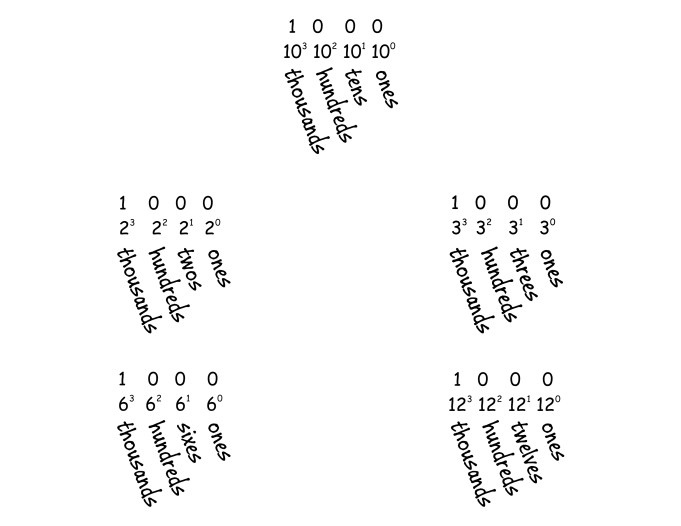
Figure 4: Naming the first four place values for five different base systems.
Look at Figures 5a and 5b. These figures show the names that I created for counting to 1310 in four different bases compared to base 10. The patterns in the naming are apparent in base 2 and base 3: one, two, one, hundred; one, two, one, thousand (base 2) and one, two, three, one, two, three, one, two, hundred (base 3). To clearly see this naming pattern, I would have to name numbers out to the third or fourth place value. However, using these first few examples, I was able to create names out to 1310 in base 6 and base 12. The only requirement is that your names follow a pattern that you can explain to another person and that this second person can then name random numbers based on your pattern.

Figure 5a: Names of numbers out to 1310 in base 2 and base 3 compared to base 10.
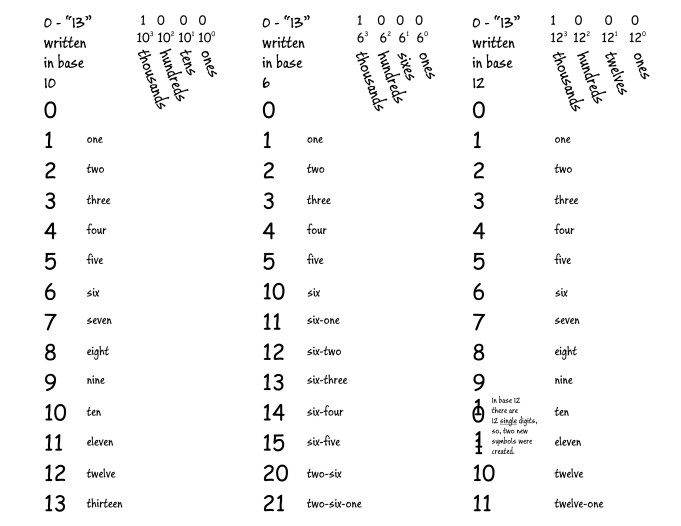
Figure 5a: Names of numbers out to 1310 in base 6 and base 12 compared to base 10.
7. Drawings and Names for 1112, 1113, and 11110
Students need practice writing numbers in different bases. Have students make drawings of what happens when one more unit is added to 111; 5 more units; 7 more units; 17 more units. Ask students to think through and explain what happens with the digits and place value. I plan to focus on comparing base 6 to base 10. I want the base to be small enough so that the drawings are not too cumbersome, but large enough so that the patterns in the drawings, digits, and place value are apparent. The naming of the numbers is optional. I might go there a bit, but not much for my sixth-graders. It is important to remember that the purpose of comparing bases is to build a solid understanding of place value in our base 10 system of numbers.
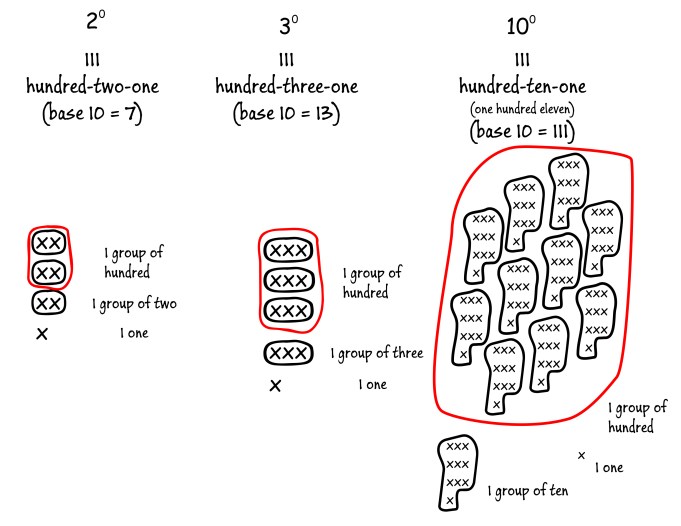
Figure 6: The number 111 written in three different bases. The drawings are similar. To make these drawings, I started with the ones place, then I drew one group of that base (the twos, threes, and tens place), then I drew the next higher place value which can be thought of as a group of a group of that base, i.e., two groups of two; three groups of three; and ten groups of ten.
 It's All About The Math