The tables are provided for my sixth-graders to design their own fraction word problems. As the title suggests, students will then investigate what happens to the quotient when they change the divisor. This first table guides students through designing an initial set of problems. The second table provides a broader, less defined set of choices.


An example problem:
A landscaper has 3 gallons of gasoline to run his leaf-blower. He uses 2/3rds of a gallon of gasoline a day to run his leaf-blower. How many days can he run the leaf-blower?
In this problem, 2/3rds of a gallon of gasoline equals one day. The number of 2/3rds he can get out of 3 gallons of gasoline equals the number of days he can run his leaf-blower. A question is what the landscaper does with a fractional amount that remains which equals a fraction of a day.
The Math:

Here is a drawing:

Notice that the first operation (3 x 3 = 9) calculates the number of thirds in the problem. The second operation (9/3 divided by 2/3 = 4.5 two-thirds, or days) calculates the number of two-thirds, or days, one can get from nine-thirds.
This drawing provides students with visual, conceptual model, and it provides the teacher with a model around which to have a conversation.
When the divisor is doubled (2-times as much), the quotient is half as much:
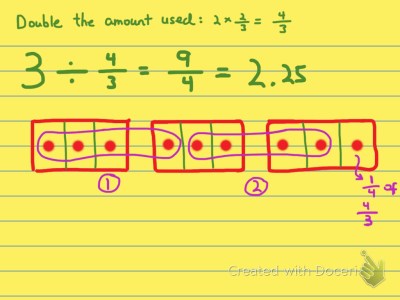
When the divisor is halved (1/2 as much), the quotient is doubled:
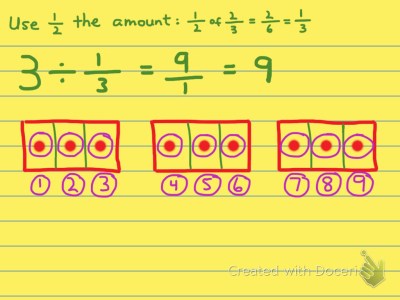
Here is a drawing of all three problems lined up to visually compare the relationship between the change in the divisor and the subsequent change in the quotient:

 It's All About The Math