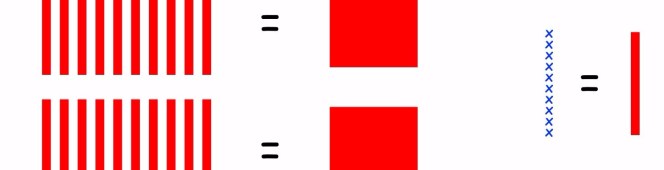
Change the Divisor; What is the corresponding change in the quotient? It’s the RECIPROCAL

Change the Divisor; What is the corresponding change in the quotient? It’s the RECIPROCAL

The tables are provided for my sixth-graders to design their own fraction word problems. As the title suggests, students will then investigate what happens to the quotient when they change the divisor. This first table guides students through designing an initial set of problems. The second table provides a broader, less defined set of choices.

building word problems

Continue reading

Place Value #1:  10 groups to groups of ten (tens)

Place Value #1: 10 groups to groups of ten (tens)

As a sixth-grade math teacher (or any math teacher fourth-grade and above), you have probably told students that the value of a digit is ten-times greater as you move each place value to the left. This is true: 5 ones becomes 50 ones (5 tens).  I have said this to my students. But, as I write these posts and think carefully about my students’ difficulty in understanding math, I realize that this simple statement is complex. To conceptualize “ten-times greater as moving from ones to tens” is difficult. Even as I write this, I think, “C’mon Steve, this is silly; 5 ones to 5 tens is ten times more. It is not that hard!”.

Continue reading

Beginning Multiplication #1

Beginning Multiplication #1

Students will begin by discussing multiplication as equal groups of things. They will provide examples of “things” and “groups”. I will give kids some things to work with: centimeter cubes, pennies, beans; and, some containers in which to place those things: plastic bowls, coffee cans, circles on paper. Take the time to have kids do this. Sixth-graders need this time. Have them think about it – all aspects of it: things, groups, equal groups – write about it, and explain it. Students should include drawings in their writing – what are the images that they are building in their heads as they work through these simple examples?

Continue reading

How to Support the Core Math Class

How to Support the Core Math Class

This next school-year, I have an opportunity to teach math within my science and social studies classes. Our sixth-graders simply need more minutes to think about and work on mathematics. The students and teachers at my school are grouped into villages of 75 to 90 students. The students are divided into three groups who move together between their math, science, social studies, language arts, PE, and exploratory classes. This next year, I will be able to take some minutes from my science and social studies classes to teach math.

Continue reading